

One contract, one SLA framework, one dispatch platform
Break-fix looks simple until it is multi-country. Then it becomes a question of who actually attends, whether the part is in the country, whether the engineer can get into the building, and whether anyone can prove afterwards what was done.
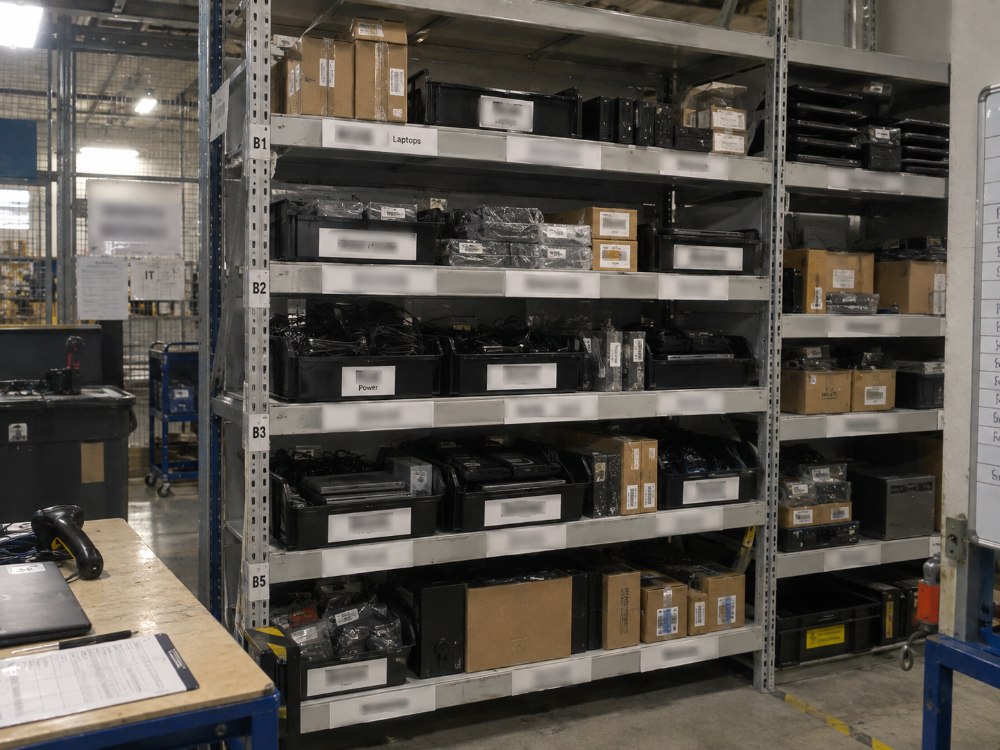
We answer those questions with directly-employed workers in nineteen country entities, spares held at nineteen owned logistics hubs, and every dispatch running through Cogent OS against your entitlement database. A thirty-country estate is one contract with one SLA framework and one monthly attainment pack - not thirty local agreements you reconcile yourself.
IMAC/D sits in the same service because the same worker, the same van and the same parts pipeline do both. A site that needs a failed switch replaced on Tuesday and forty desk moves on Saturday should not need two suppliers.
The environment changes everything
The same broken laptop is a different job in a trading office, a hyperscale hall and a paint shop. We scope, staff and induct per environment rather than sending a generalist and hoping.
Data centre
White-space work under the operator's rules, by workers with current inductions and clearance held in Cogent OS so an expired credential cannot be dispatched.
Office / corporate
Desk-side work where the user is watching, so etiquette and discretion matter as much as the fix itself.
Manufacturing / industrial
Shop-floor work where downtime is measured in stopped output and safety documentation is not optional.
What L1 and L2 actually mean here
Published so there is no argument on site about whether a task is in scope. Anything beyond L2 escalates to our engineering practices or to your own teams, with the handover recorded on the work order.
| DOMAIN / DEVICE | L1 - SWAP & BASIC | L2 - DIAGNOSE & CONFIGURE |
|---|---|---|
| EUC - Laptops & desktops | Like-for-like swap, imaging from staged build, peripheral reconnection, user data transfer from backup, asset tag and CMDB update | Hardware fault diagnosis, component-level repair (RAM, SSD, battery, screen), OS and driver remediation, encryption and domain re-join verification |
| EUC - Mobiles & tablets | Device swap, SIM transfer, enrolment prompt, accessory replacement | MDM enrolment troubleshooting, profile and policy verification, carrier and eSIM issue diagnosis |
| EUC - Peripherals & docks | Replace monitor, dock, keyboard, headset; verify function | Multi-monitor and docking-chain fault isolation, firmware update on docks and displays |
| EUC - Printers & MFDs | Consumable replacement, jam clearance, connectivity check, unit swap | Print queue and driver diagnosis, network and scan-to-folder configuration, firmware update |
| EUC - POS & kiosks | Terminal, printer, scanner or pinpad swap; till settlement test | Peripheral chain diagnosis, payment-device pairing, configuration restore and verification |
| Network - Switches | Chassis or unit swap, cable reseat, port patching to schedule, power verification | Config restore from backup, VLAN and port profile verification, firmware update, stack member replacement |
| Network - Access points | AP swap on existing mount, PoE verification, label and record update | Controller adoption, channel and power verification, post-swap coverage spot-check |
| Network - Routers & firewalls | Unit swap, cabling, console cable presentation for remote engineer | Config load and verification, WAN circuit test-and-turn-up, failover validation |
| Network - Cabling & patching | Patch lead replacement, port moves to schedule, labelling | Fault trace and certified re-test, containment remediation, as-built schedule update |
| Network - SD-WAN edge | Appliance swap, LAN and WAN cabling, activation call to your NOC | Zero-touch provisioning support, circuit validation, tunnel and policy verification with your team |
Any activity requiring architectural change, vendor TAC engagement or production configuration authorship is escalated rather than improvised. The escalation, and who accepted it, is recorded on the work order.
Five SLA tiers, and the parts strategy behind each
An SLA is only as good as the spare part behind it. Each tier below is priced with an explicit parts strategy, because a four-hour promise with a next-day part is not a four-hour service.
| TIER | RESPONSE DEFINITION | TYPICAL USE CASE | COVERAGE WINDOW | PARTS STRATEGY |
|---|---|---|---|---|
| 2H - Critical | Worker on site within two hours of dispatch, 24/7 including weekends and public holidays | Trading floors, data centre production, revenue-critical POS clusters, manufacturing lines | 24/7/365 | Customer-owned spare held on site, or a dedicated locker within the response radius |
| 4H - High | Worker on site within four elapsed hours during the contracted window | Branch networks, key offices, distribution centres, clinical areas | 24/7 or extended business hours | Forward-stocked at the nearest of our nineteen owned hubs, drawn on dispatch |
| NBD - Next business day | Attendance on the next working day for tickets logged before the agreed cut-off | Standard office estates, secondary sites, non-critical peripherals | Business hours, local calendar | Hub stock with same-day courier to site or worker, consolidated per route |
| 2BD - Second business day | Attendance within two working days | Low-density sites, remote locations, low-criticality devices | Business hours, local calendar | Hub stock, standard courier, batched with other visits in the area |
| Planned / scheduled | Booked slot agreed with the site, including out-of-hours and weekend windows | IMAC/D batches, refresh waves, cabling works, planned swaps | By arrangement, including nights and weekends | Kitted per site at the hub and shipped to arrive with the worker |
Response times are measured in Cogent OS from dispatch, against the site's local working calendar. Attainment is published per tier, per country, every month. Where a site's distance from the nearest entity makes a tier unrealistic, we say so during scoping rather than signing and missing it.
From ticket to billing, without a phone call
Entitlement, parts and worker matching are automated against your contract and our stock. The human decisions are the ones that need judgement - not looking up whether a site is covered.
Aligned to ITIL incident and request management. Change-affecting work is routed through change management with CAB approval before attendance.
How a thirty-country estate actually runs
Multi-country field services fail on governance, not on technicians. The structure below is what we put in place on day one of a global programme, and it is the same structure whether you have four countries or thirty.
One programme manager owns the contract and the monthly pack. Regional delivery leads own attainment in EMEA, APAC, LATAM and USCA. An entitlement database holds every site, its SLA tier, its access requirements and its named contacts, so a ticket raised at three in the morning routes correctly without anyone interpreting it.
Spares are forward-stocked per region against the failure profile of your estate, reviewed quarterly. Where a country falls outside our nineteen entities we serve it from the nearest one and tell you what that means for response and parts before you sign, rather than after you escalate.
Install, move, add, change, dispose
The lifecycle work that keeps an estate accurate. Each activity closes with the asset record updated, which is what stops the register drifting from reality.
Measured per tier, per country
A delivered programme
A global hospitality group needed its end-user estate refreshed across 1,386 sites - including islands and hard-to-reach locations - and then supported in life. The IMAC programme decommissioned the legacy devices at every site, deployed the new estate, and migrated user data with backup verified before anything was retired.
We consolidated the estate onto one contract with a single SLA framework, built the entitlement database site by site, and forward-stocked spares against the actual failure profile at our owned hubs in the relevant countries. Directly-employed workers were assigned per region, with clearances and inductions tracked in Cogent OS so scheduling could never breach site rules. 800 workers delivered the programme to a two-business-day IMAC SLA - islands included - with every visit evidenced.
The refresh completed at 100% SLA attainment, and the estate then moved into steady-state break-fix on same-business-day and next-business-day SLAs, holding 98.1% attainment. One contract, one SLA framework, one platform - from decommission to daily support.
Anonymised by agreement. Client names available under NDA.
Questions buyers ask
Who owns the spare parts - you or us?
Either model works and we price both. Customer-owned stock is held in a segregated bay at our hub, visible to you in the portal at serial level, and drawn down against your work orders only. Cogent-owned stock means we carry the inventory risk and bill per incident or as part of the managed fee. Two-hour tiers usually need customer-owned spares on site or in a nearby locker; four-hour and next-business-day tiers are normally served from our hub stock.
Do you coordinate warranty claims with the OEM?
Yes, where warranty management is in scope. We diagnose, raise the claim with the manufacturer, handle the RMA logistics through our hub, and track the replacement to closure against the original work order - so the asset record shows the fault, the claim and the resolution in one place rather than in an inbox.
How do you handle site access and clearances?
Access requirements live in the entitlement database per site: badging process, induction requirement, escort rules, permitted hours and named contacts. Worker clearances and induction validity are held in Cogent OS with expiry dates, and dispatch is blocked against an expired credential. For data centre and secure sites we maintain a dedicated pool of cleared workers rather than sending whoever is nearest.
Can you work out of hours and at weekends?
Yes. Planned work is routinely scheduled into evenings and weekends because that is when sites can release equipment, and critical tiers are covered 24/7 including public holidays where contracted. Out-of-hours cover is priced explicitly rather than hidden in an average rate, so you can see what the window costs.
How does invoicing work across many countries?
One consolidated invoice from the contracting entity, with a per-country and per-site breakdown reconciled against completed work orders. Multi-entity and multi-currency billing happens inside Cogent OS, so the line items on your invoice trace back to individual work orders you can open in the portal.
Other field service lines
Need hands on site, reliably?
Tell us the countries, the sites and the response times. We will show you which entity attends, which hub holds the spares and what each SLA tier costs.