

What we have already built
Delivered by our own DC-cleared workers, on Cogent OS, under change control - floor plan to final commissioning.
Data centre work is unforgiving
The window is fixed, the site rules are absolute, and a cabling shortcut taken in week one is still visible in year five. There is no version of this work where improvisation is cheaper than drawings.
So we design first. Our design team produces the full pack - floor plans, data-point schedules, rack layouts and elevations, power budgets and port maps - and the build is executed from those drawings. Crews arrive knowing which cable goes to which port, in which cabinet, at which U position, before a single cable is pulled.
The result is an as-built pack at handover that matches reality, because the evidence was captured as the work happened rather than reconstructed afterwards. Every rack, run, serial and test result lands in Cogent OS against the asset register.
Twelve steps, twelve deliverables
Each step closes with a document, not a verbal handover. The pack that accumulates is the handover pack.
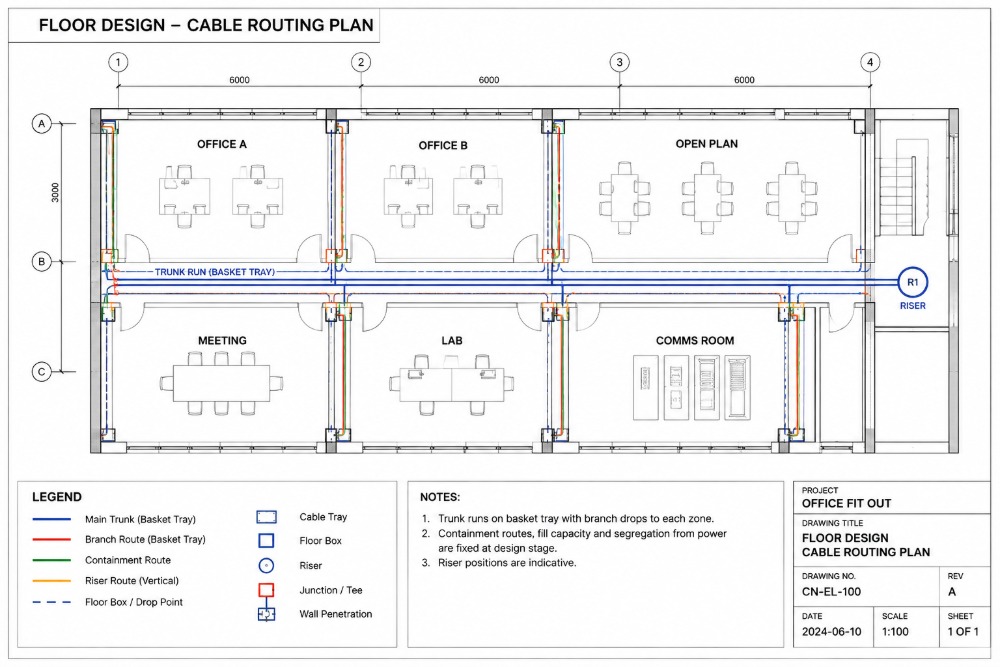
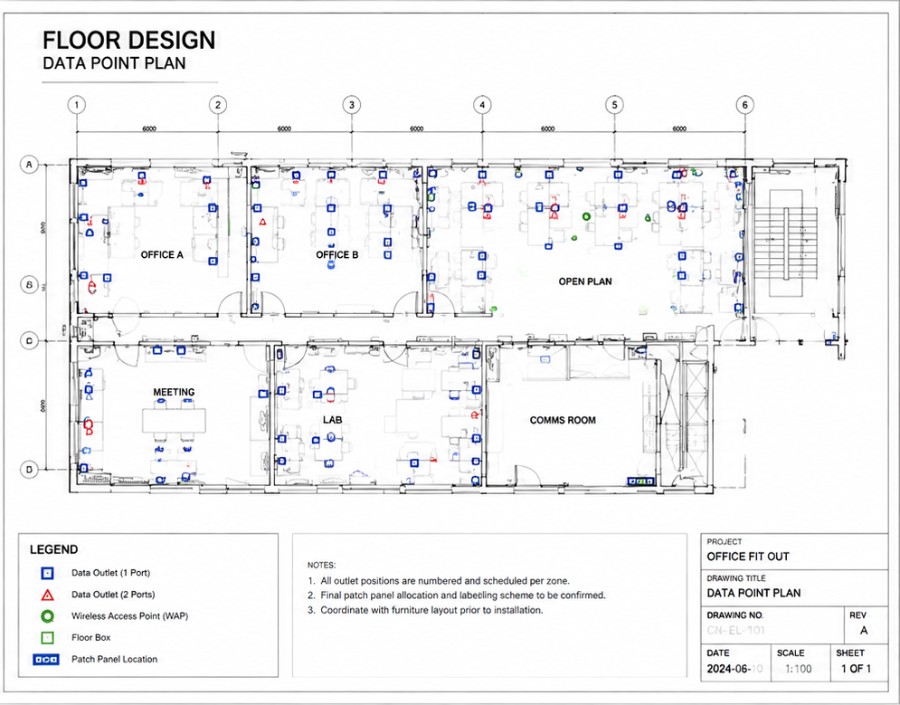
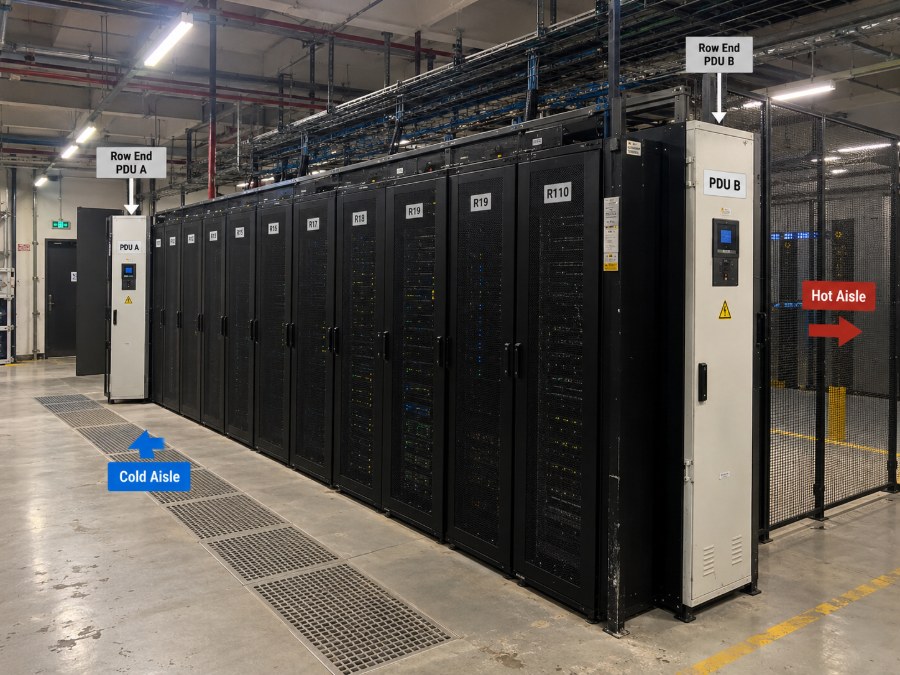
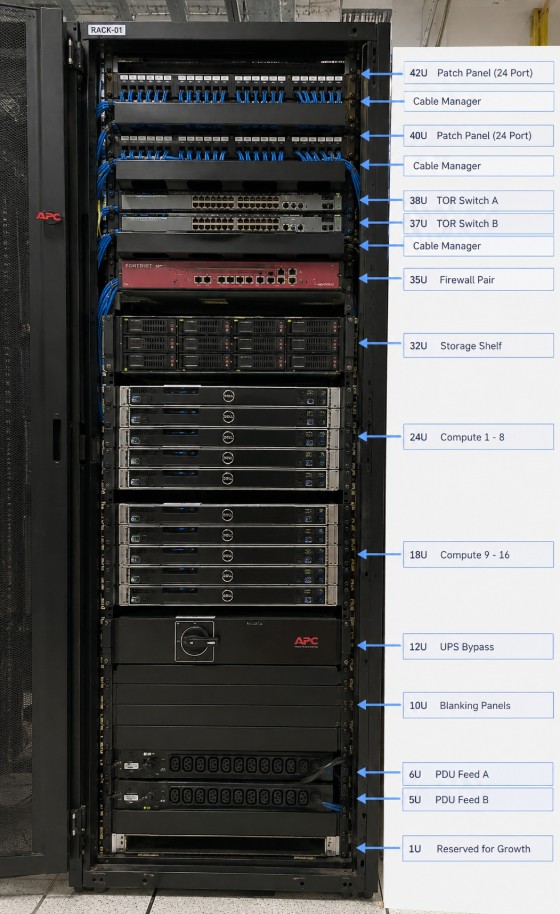
Floor plan to rack elevation
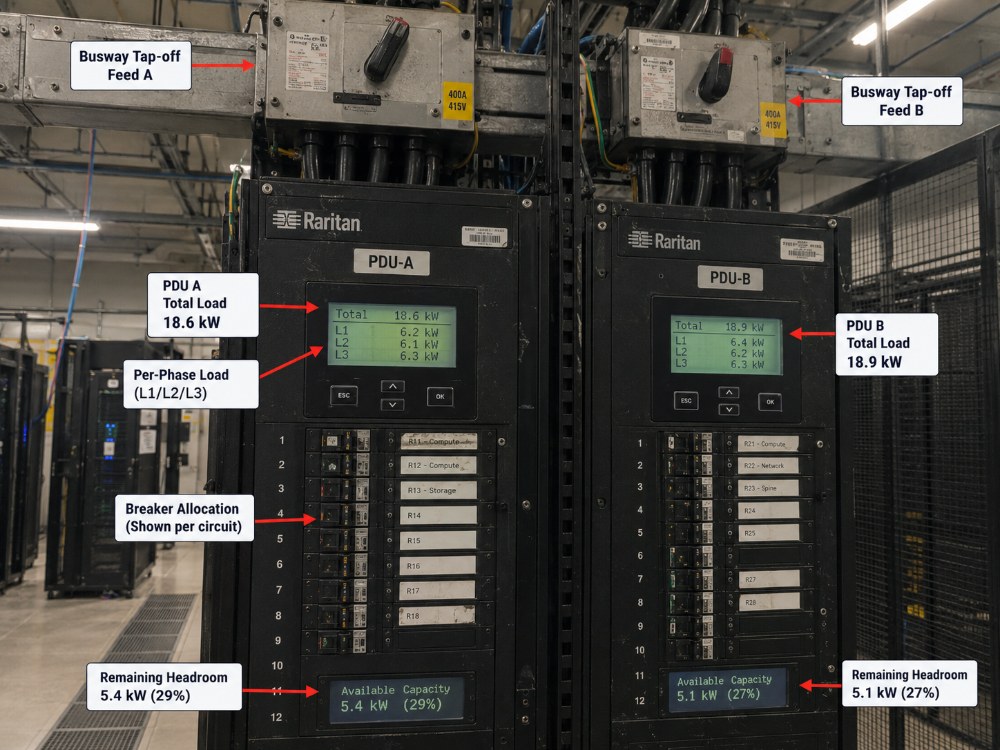
Five documents carry a data centre build. They are produced before mobilisation and updated as-built at handover, so the drawing and the room agree.
Port-level engineering
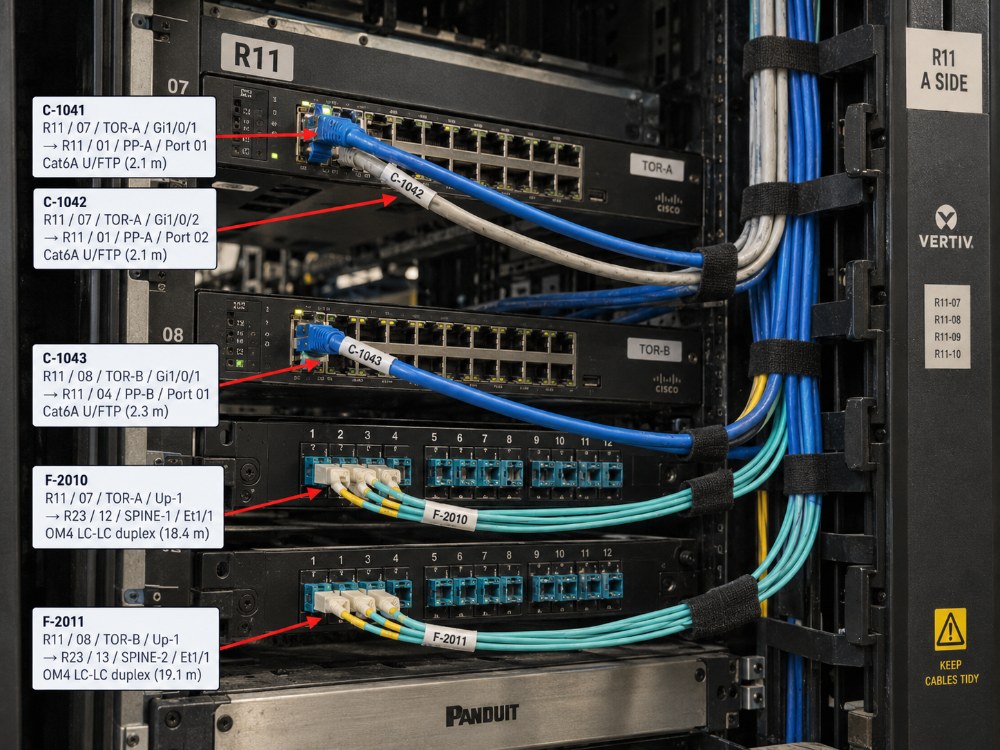
Every port, every cable, documented before a single cable is pulled. The port map is the instruction the crew works from and the record the client keeps.
| CABLE ID | A-END (RACK / U / DEVICE / PORT) | B-END (RACK / U / DEVICE / PORT) | TYPE | LENGTH |
|---|---|---|---|---|
| C-1041 | R11 / 07 / TOR-A / Gi1/0/1 | R11 / 01 / PP-A / Port 01 | Cat6A U/FTP | 2.1 m |
| C-1042 | R11 / 07 / TOR-A / Gi1/0/2 | R11 / 01 / PP-A / Port 02 | Cat6A U/FTP | 2.1 m |
| C-1043 | R11 / 08 / TOR-B / Gi1/0/1 | R11 / 04 / PP-B / Port 01 | Cat6A U/FTP | 2.3 m |
| F-2010 | R11 / 07 / TOR-A / Up-1 | R23 / 12 / SPINE-1 / Et1/1 | OM4 LC-LC duplex | 18.4 m |
| F-2011 | R11 / 08 / TOR-B / Up-1 | R23 / 13 / SPINE-2 / Et1/1 | OM4 LC-LC duplex | 19.1 m |
Sample rows shown. A full port map covers every link in the build, cross-referenced to the cable schedule, the patch panel allocation and the labelling scheme. Port-stripping layouts are produced where existing plant is being re-terminated.
Survey and audit discipline
An audit that changes the thing it is auditing is worthless. Our standing survey law is simple: never touch a device or a cable during a survey. Observe, photograph, record, report - then raise the change if something needs doing.
Surveys use a fixed template so two crews in two countries produce comparable output: U-by-U front and rear inventory, manufacturer, model and serial capture, PDU and power-socket schedule, grounding and lock checks, and a photograph of any device not showing a green status LED.
Everything lands in Cogent OS against the asset register, so the audit becomes the CMDB baseline rather than a spreadsheet that ages in a folder.
U-by-U inventory
Front and rear, every U accounted for - occupied, blanked or free - with position recorded against the cabinet.
Asset capture
Manufacturer, model and serial captured per device and written to the asset register, not transcribed later.
Power schedule
PDU inventory and socket-by-socket allocation, including which feed each device draws from.
Grounding & locks
Bonding and earthing verified, cabinet locks and door state checked and recorded.
Non-green-LED photo rule
Any device not showing a healthy status indicator is photographed and flagged, whether or not it is in scope.
Never touch
No device, cable or breaker is moved during a survey. Findings become change records, not on-the-spot fixes.
Standards, and the craft on top of them
We install to ANSI/TIA-568 and ISO/IEC 11801: multi-vendor generic cabling carrying voice and data, defined subsystems, specified connector and pin assignments, topology and distance rules, a design life beyond ten years, backward compatibility and uniform documentation.
Why the standard matters commercially
A generic cabling system is vendor-independent, so you are not locked to the equipment brand that happened to be current when the room was built. Defined subsystems and distance rules mean the plant supports the next two generations of active kit, and uniform documentation means the next engineer can read it.
The practical test is whether a link certifies. Standards compliance is not a claim on a datasheet; it is a measured result per link, signed and dated.
Every copper link, 17 parameters
Each permanent link up to 90 m is tested and certified against the full parameter set, with results issued per link:
Fibre links are certified by OTDR trace plus optical loss test set. Certification results form part of the handover pack and the warranty position on the plant.
The cabling dress code
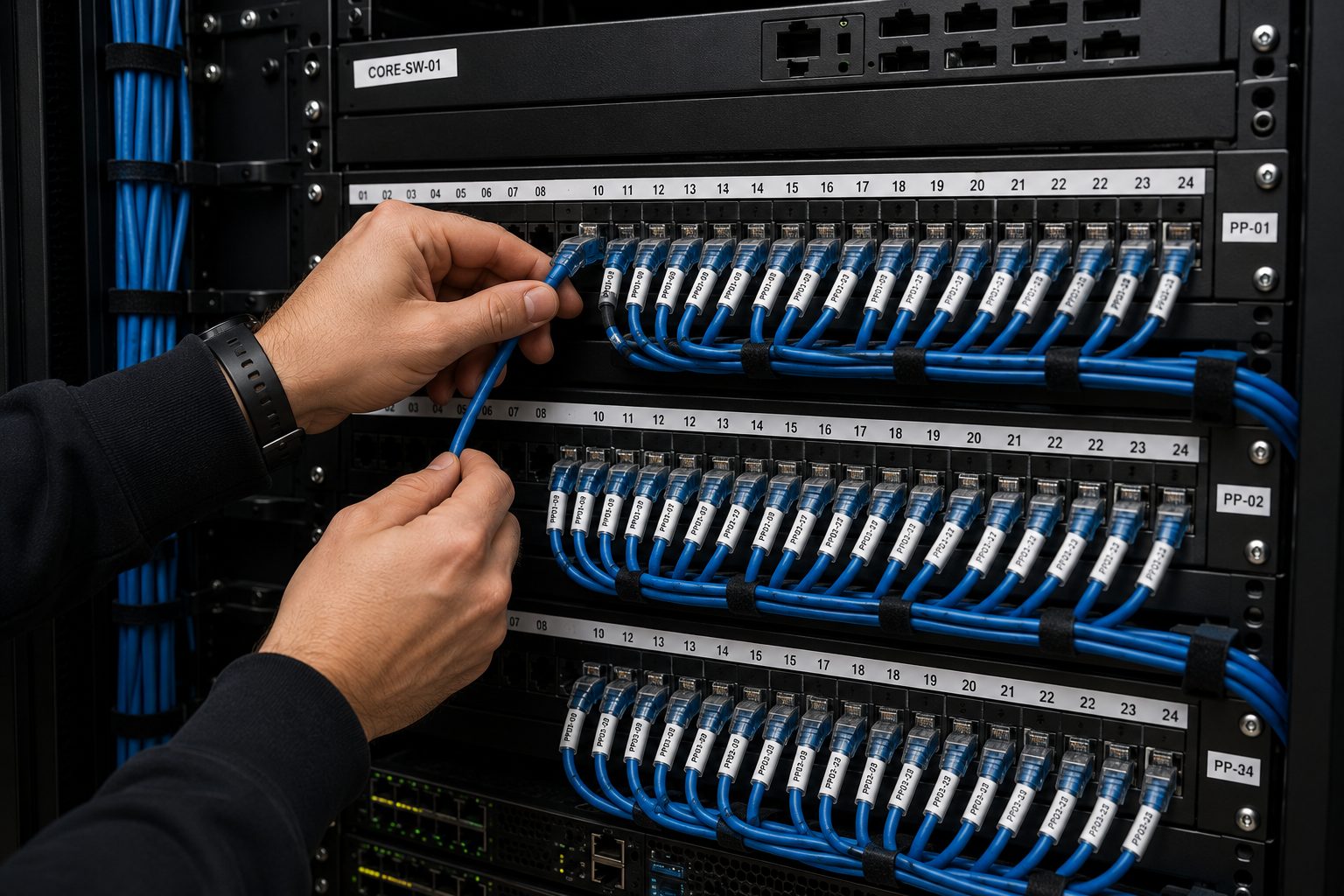
A documented standard applied identically in every hall and every country - because dressing and labelling are what make a room maintainable five years after handover. Every cable, device and port is label-printed to the client's scheme where one exists, or to ours where it does not.
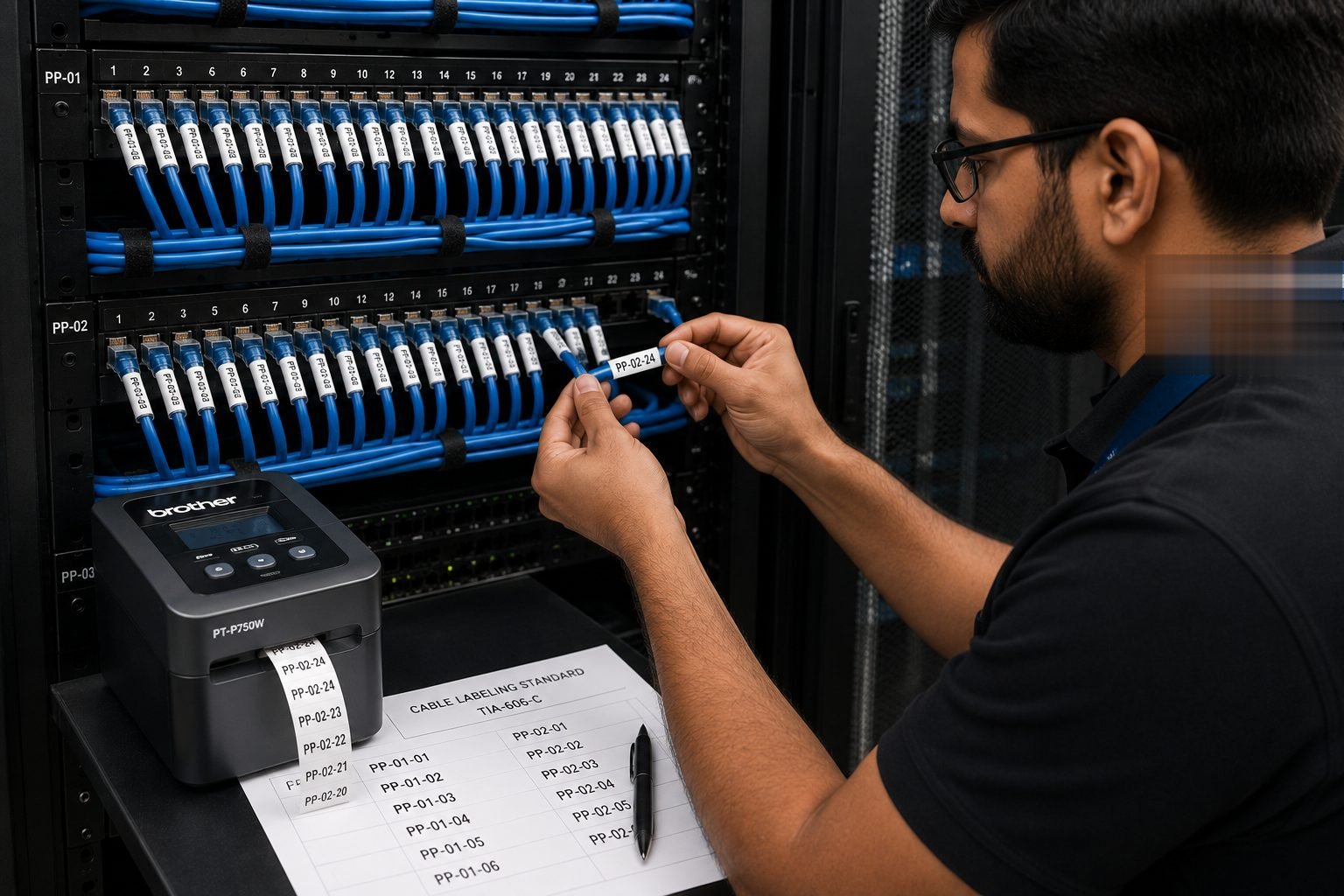
What a dressed rack looks like
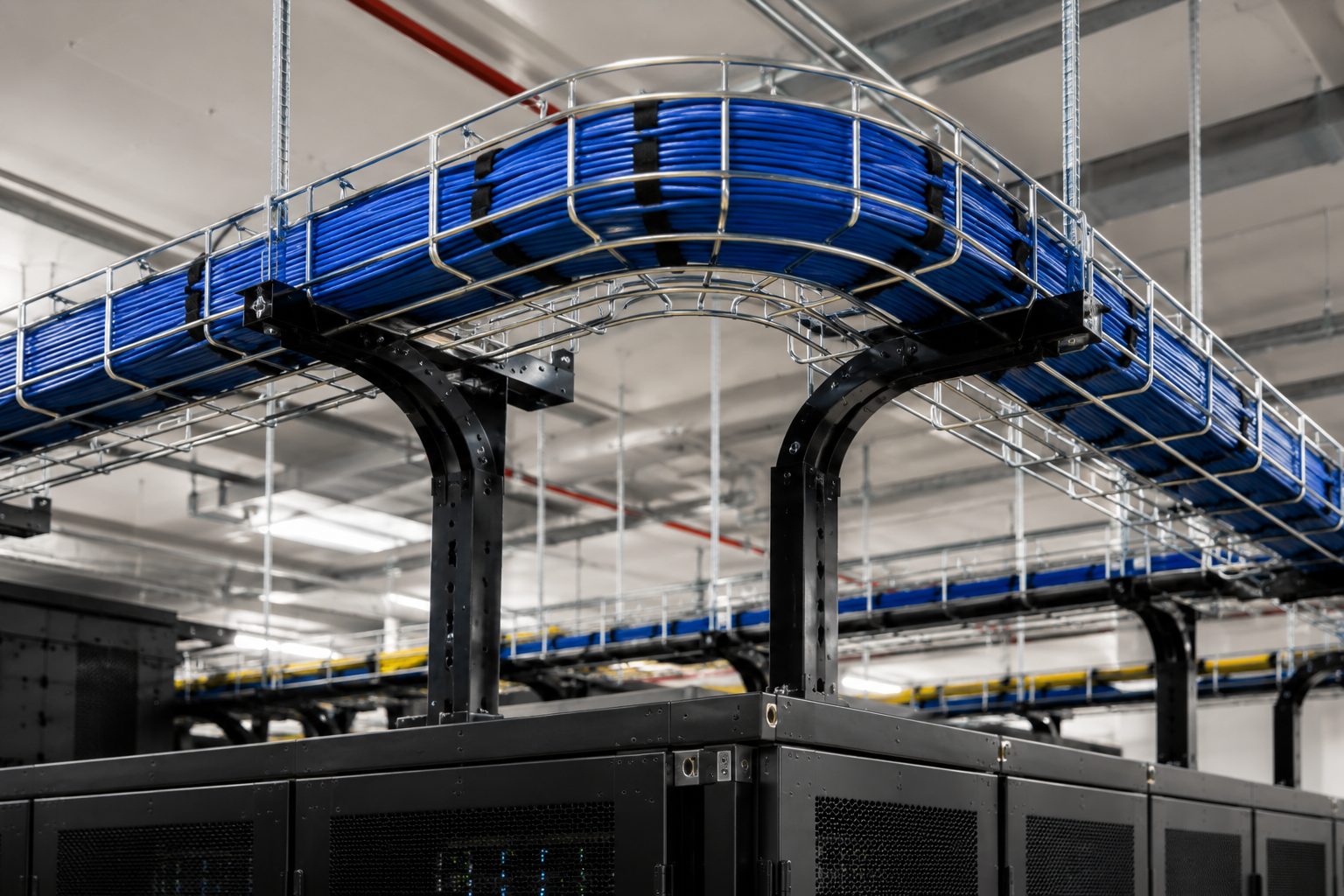
The discipline in the figure is what separates a rack that can be worked on from one that has to be unpicked.
Crews, supervision and safety
Experienced crews install network devices and servers to a documented standard: mount, connect, label, power-on test. Nothing is signed off on the basis that it looked right.
Every deployment runs under an on-site project manager who supervises against the initial design rather than against the crew's judgement on the day. Where the room does not match the drawing, that is a change record and a decision - not a quiet deviation discovered at commissioning.
The project manager also owns safety: PPE discipline, working-at-height controls, method statements and risk assessments per visit, permit compliance, and incident handling and reporting. On a live floor those are not administrative overheads; they are the reason the operator lets us back in.
Mount
To elevation, at the specified U, with correct rails and cage nuts, load-checked.
Connect
To the port map, with cable type and length as designed, dressed as installed.
Label
Every cable, device and port printed to the agreed scheme, both ends.
Power-on test
Verified against expected state, with any non-green indicator photographed and raised.
Once the hall is live
Build is one engagement. Most clients keep us for the operational bands below, delivered by the same cleared workers who built the room.
Field services & IMAC/D in the DC
Reactive break-fix and lifecycle moves inside the hall, under change control with two-person discipline on production-affecting work.
Data centre L2 support
Hands-on technical support beyond remote scope: diagnosis, configuration to procedure, firmware and structured fault isolation.
Test lab & specialised facility
A controlled environment for build validation, burn-in, firmware baselining and pre-production testing before kit reaches your floor.
Rack logistics from our hubs
Cabinets built, populated, cabled, labelled and burned in at the nearest owned hub, then delivered ready to energise.
Relocation & migration
Move-group planning with rollback positions, sequenced power-down and power-up, and chain of custody per asset.
Secure decommission
Controlled de-rack straight into our ITAD line, with data destruction and a certificate per asset.
NOC
Monitoring and first-line response on infrastructure and network, with alerting integrated into the same ticket model.
SOC
Security monitoring and incident response alongside the operational picture, rather than in a separate silo.
One process, inside the operator's rules
Production-affecting work runs against an approved RFC through change advisory board approval, with the two-person rule applied where the site or change class requires it.
Three things clients tell us they did not expect
Rack design expertise
Layout is optimised for performance, heat dissipation, tidiness and future growth - not just for fitting the equipment in. Reserved U space, blanking discipline and cable-manager placement are design decisions, and they are the difference between a cabinet you can work in and one you fight.
Third-party coordination
We manage the other vendors around the project - cabling contractors already appointed, OEM engineers, the operator's own facilities team, mechanical and electrical contractors - so you have one point of contact rather than arbitrating between suppliers on the critical path.
L3 design authority
Certified senior workers across major network, server and wireless platforms are available for solution design and urgent escalation. That means a design question does not wait for a vendor SLA, and a production escalation reaches someone with authority rather than someone reading a script.
A delivered engagement
A financial services client took 5,000 square metres of new office space in London for more than 100 users, with a fixed occupation date and no IT presence on the ground. The requirement was everything: cabling design, structured cabling, a wireless survey and deployment, and the network built and working.
We surveyed and produced the design pack first - cable routing plan, data-point schedule for 183 outlets, comms room rack layout and elevation, and the power budget. Delivery then ran in three phases: trunking and cable pulling to the routing plan, termination and dressing to the cabling dress code with every link certified, then finalisation - network configuration, wireless validation survey against the design, labelling and the as-built handover pack.
The site was handed over turn-key in 20 days from survey to acceptance, with certification results per link, an as-built pack matching the room, and the asset register loaded into Cogent OS so the estate was documented from day one rather than reconstructed later.
Anonymised by agreement. Client names available under NDA.
What we work to
Governance on site is as documented as the engineering: dress code, facility inductions per worker with tracked expiry, permits and method statements per visit, escorted access where the operator requires it, and photographic evidence against the standard for every task.
Service levels
| PRIORITY | DEFINITION | RESPONSE | TARGET RESOLUTION | WINDOW |
|---|---|---|---|---|
| P1 - Critical | Production hall, feed or core network affected | 15 minutes | 4 hours | 24/7/365 |
| P2 - High | Redundancy lost or a rack group degraded | 30 minutes | 8 hours | 24/7/365 |
| P3 - Medium | Single device or non-redundant component failed | 2 hours | Next business day | Business hours |
| P4 - Low | Planned works, IMAC batch, scheduled audit | 8 hours | To agreed schedule | By arrangement |
| Change window | Production-affecting works under approved RFC | Booked in advance | Inside the agreed window | Nights and weekends as required |
Measured in Cogent OS against the operator's site calendar. Production-affecting work is never performed outside an approved change window, regardless of priority - the escalation path in that case is to the change process, not around it.
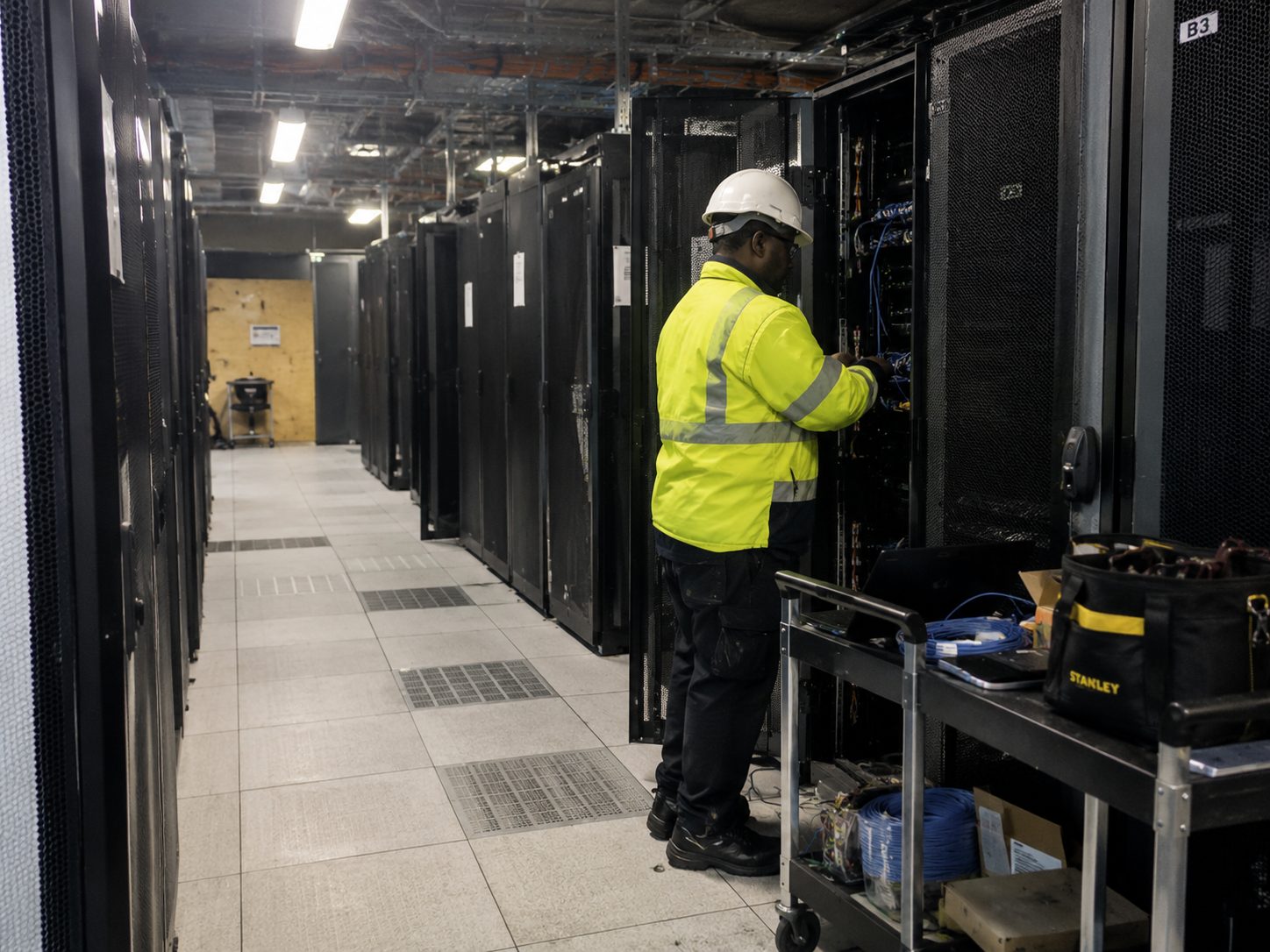
The environment we work in
Questions buyers ask
Can you work in a live hall?
Yes, and most of our work is in live environments. It is governed rather than casual: production-affecting tasks run against an approved RFC through change advisory board approval, inside a booked window, with the two-person rule applied where the site or change class demands it. Surveys are non-invasive by rule - we do not touch a device or cable during an audit.
How do you handle clearances and site inductions?
Induction and clearance validity is held per worker in Cogent OS with expiry dates, and dispatch is blocked against an expired credential - so access is never the reason a window is missed. For operators with their own vetting requirements we maintain a dedicated pool of cleared workers for those facilities rather than sending whoever is nearest.
Can cutovers run out of hours?
Yes, and for live halls they usually must. Night and weekend windows are planned into the programme from the start, with the crew, the parts and the rollback position all booked to the window rather than arranged on the night. Out-of-hours cover is priced by window explicitly rather than averaged into a day rate.
What as-built documentation do we receive?
The design pack updated to as-built: cable routing and data-point plans, rack layout and U-by-U elevations, power and socket schedule, the full port map, certification results per copper and fibre link, commissioning results by level, and the asset register with serials. It is issued in portable formats you own, and loaded into the CMDB if we operate the estate.
Is there a warranty on the cabling plant?
Yes. Installation workmanship is warranted, and where the engagement uses a manufacturer's components to their specification, the extended system warranty available on that plant is registered on your behalf. Certification results per link are what make that warranty claimable, which is another reason every link is tested rather than sampled.
Got a hall to build, or an estate to move?
Tell us the floor, the capacity and the window. We will come back with the design approach, the crewing plan and the commissioning schedule.