

What we have already built
Delivered by our own DC-cleared workers, on Cogent OS, under change control - floor plan to final commissioning.
Twelve steps, floor plan to commissioning
Each step closes with a deliverable. See the full lifecycle and design pack →
What this practice does
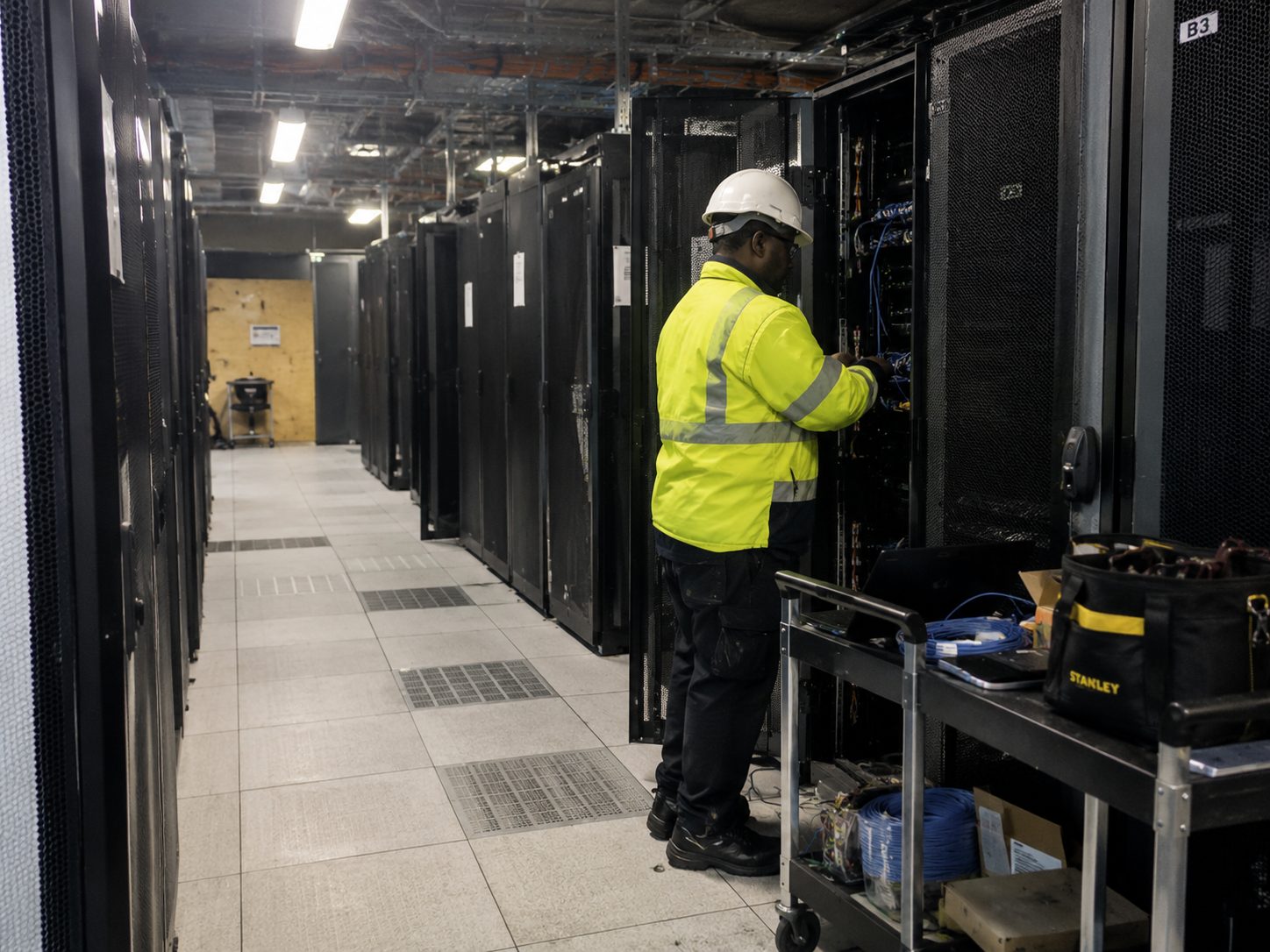
Data centre work is unforgiving: the window is fixed, the site rules are absolute, and a cabling shortcut taken in week one is still visible in year five. Our Data Centre practice is built around that reality - documented standards, DC-cleared workers, and evidence captured as the work happens rather than reconstructed afterwards.
The scope runs from design and site survey through cable routing, data point and rack layout design, power consumption planning, build and fit-out, rack and stack, structured cabling, power and cooling, configuration and commissioning through levels one to five. Migration, relocation and controlled decommissioning with certified disposal close the lifecycle.
On the compute side we integrate current-generation NVIDIA, AMD and Intel platforms, including high-density and liquid-cooling-ready deployments, in our own hubs or on your floor. Racks can be built, populated, cabled, labelled and burned in at one of our nineteen owned logistics hubs, then delivered to site ready to energise.
Data Centre at the centre
Each service line is its own contractable scope, and each runs on the same platform - so you can start with one and add the others without changing tools, portals or account teams.
Capabilities across the practice
Site Survey & Design
Floor, power, cooling and containment survey; cable routing, data point and rack layout design; power consumption modelling.
Build & Fit-Out
Containment, cabinets, PDUs, basket and tray, labelling schemes and white-space preparation to the agreed standard.
Rack & Stack
Receipt, mount, cable, label and power on, to a documented installation standard with photographic evidence.
Structured Cabling
Copper and fibre, dressing and containment discipline, certified testing and as-built documentation.
Power & Cooling
A and B feed discipline, busbar and whip drops, PDU allocation and airflow management with blanking.
Commissioning Cx L1-L5
Factory, component, system and integrated systems testing, with documented results and handover packs.
Migration & Relocation
Move-group planning, chain of custody, sequenced power-down and power-up, rollback positions and validation.
Decommissioning & ITAD
Controlled de-rack, data destruction to NIST 800-88, certified disposal and WEEE reporting.
Data centre delivery lifecycle - end to end on Cogent OS
The lifecycle on the left, the platform tooling that runs it in the middle, and the quality loop that holds it on the right. This is the same structure across all eighteen service lines, tuned per practice.
Measured, not asserted
One SLA framework, applied here too
| PRIORITY | DEFINITION | RESPONSE | TARGET RESOLUTION | UPDATES |
|---|---|---|---|---|
| P1 - Critical | Service down, site or revenue-critical system unavailable | 15 minutes | 4 hours | Hourly |
| P2 - High | Major degradation or a group of users affected | 30 minutes | 8 hours | Every 2 hours |
| P3 - Medium | Single user or non-critical function impaired | 2 hours | Next business day | Daily |
| P4 - Low | Request, change or scheduled work | 8 hours | 5 business days | On progress |
Indicative framework - targets are agreed per contract and measured in Cogent OS against the ITIL priority matrix. Attainment reported monthly and reviewed at QBR.
Four things that are hard to copy
DC-cleared, directly-employed
Vetted workers with current inductions, tracked in Cogent OS so an expired clearance cannot be dispatched.
Staging in our own hubs
Racks built, populated, cabled and burned in at our hub, then delivered ready to energise - less time in your window.
One standard, evidenced
The same installation and cabling standard in every hall and every country, with photographic as-built evidence.
Exit handled properly
Decommissioning with chain of custody, NIST 800-88 destruction and certified WEEE reporting, not a skip.
Questions buyers ask
Can you work inside a hyperscale or colocation operator's rules?
Yes - it is most of what this practice does. That means workers with current site inductions and clearance, method statements and risk assessments per visit, escorted access where required, strict change-window discipline and the operator's own documentation standards. Clearance validity is tracked in the platform so scheduling cannot breach it.
What does commissioning L1 to L5 include?
Level one is factory and component acceptance; level two is component-level site verification; level three is system-level functional testing; level four is integrated systems testing across power, cooling and IT load; level five is sustained-load and failure-mode validation. Each level produces documented results that form part of the handover pack.
Do you handle high-density and liquid-cooled deployments?
Yes. We integrate current NVIDIA, AMD and Intel platforms including high-density configurations, and prepare and deploy liquid-cooling-ready racks. The practical constraints - floor loading, feed capacity, containment and manifold routing - are addressed at design stage rather than discovered at install.
How do you approach a live migration?
By move group, with rollback positions. We build the dependency map, agree groups that can move together, sequence power-down and power-up, run validation before releasing each group back to service, and hold a rollback position at every gate. Chain of custody is recorded per asset, and the CMDB is updated as groups land.
Can you decommission and dispose of the old estate?
Yes, and clients often engage us for exactly the build-and-exit pair. De-rack, chain of custody, data destruction to NIST 800-88 with certificates per asset, resale or recycling through our NAID AAA and R2v3 aligned process, and WEEE reporting for the audit file.
Where this connects
This practice's service lines
Ready to scope this?
Tell us the countries, the sites and the service levels. We will show you which entity, which hub and which workers deliver it.