

Most WiFi problems were designed in
When users complain about WiFi, the cause is rarely the access points. It is usually a design that counted rooms instead of clients, ignored what the walls are made of, put every AP on the same channel, or was never validated against the assumptions it was built on.
We treat wireless as an engineering discipline with deliverables. Predictive modelling in Ekahau AI Pro before anyone travels; on-site passive, active and spectrum survey with Sidekick 2 to test the model against reality; deployment by our own workers; then a validation survey that certifies the installed network against the design targets.
We are vendor-neutral. If you own Meraki, Aruba, Ruckus, Cisco or Ubiquiti, we design and deploy on it. The survey does not change because of the logo on the AP.
Four survey types, and when each is right
Buying the wrong survey is the most common wireless procurement mistake. Predictive design without validation is a model; validation without design is an opinion.
1 · Site discovery & scoping
The unglamorous groundwork that makes everything after it accurate. Wrong floorplans produce wrong designs regardless of tooling.
2 · Predictive design
Modelling in Ekahau AI Pro so AP count, placement and channel plan are engineered before a single mount is drilled.
3 · On-site survey
Passive, active and spectrum walks with Sidekick 2, because buildings do not read the model.
4 · Post-install validation
The survey that turns a deployment into a documented outcome, and the one most often skipped.
What you actually receive
A wireless engagement should leave you with documentation you can hand to any engineer, in any year, and have them understand the network.
| DELIVERABLE | WHAT IT CONTAINS | WHEN IT IS ISSUED |
|---|---|---|
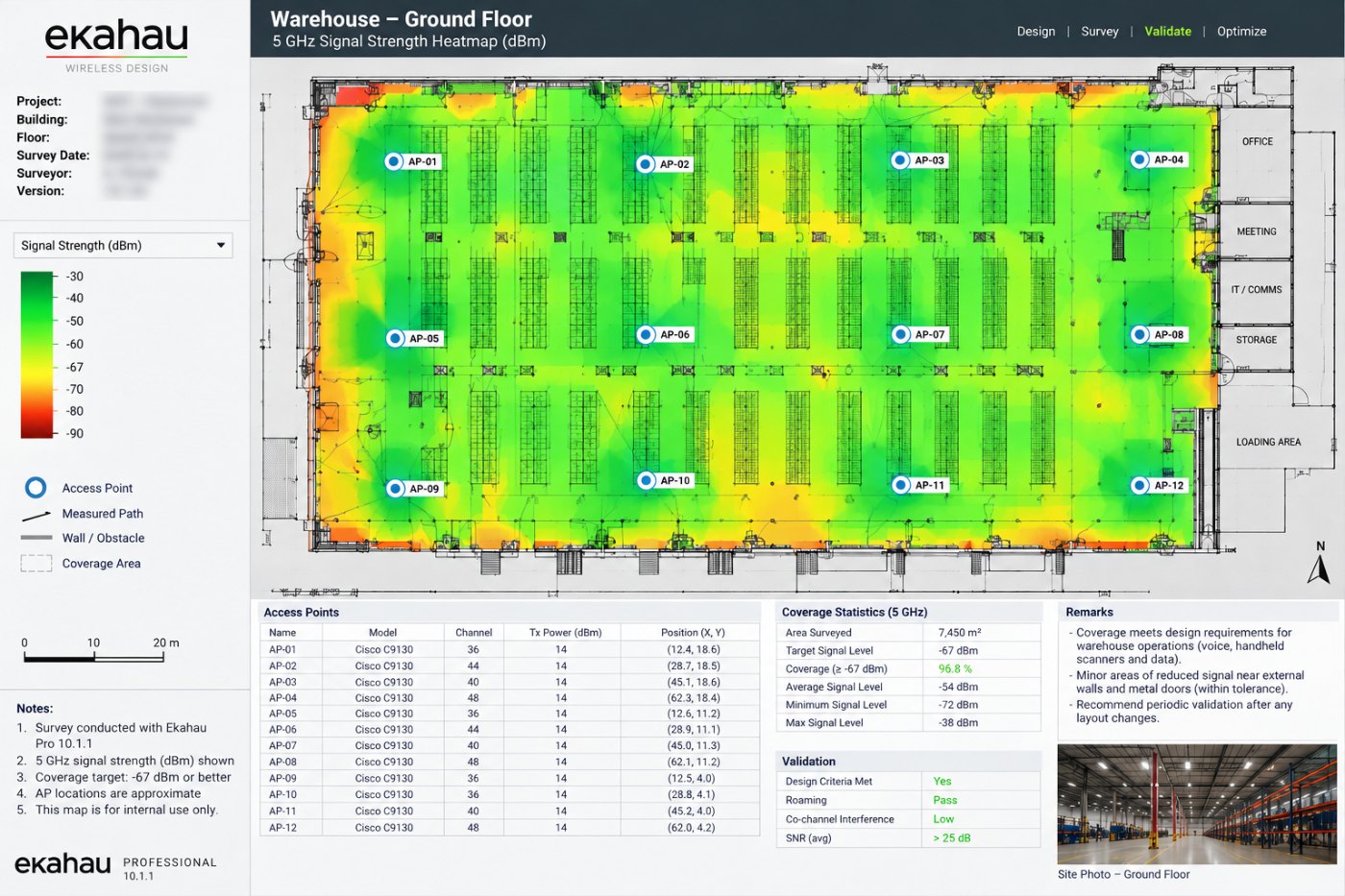
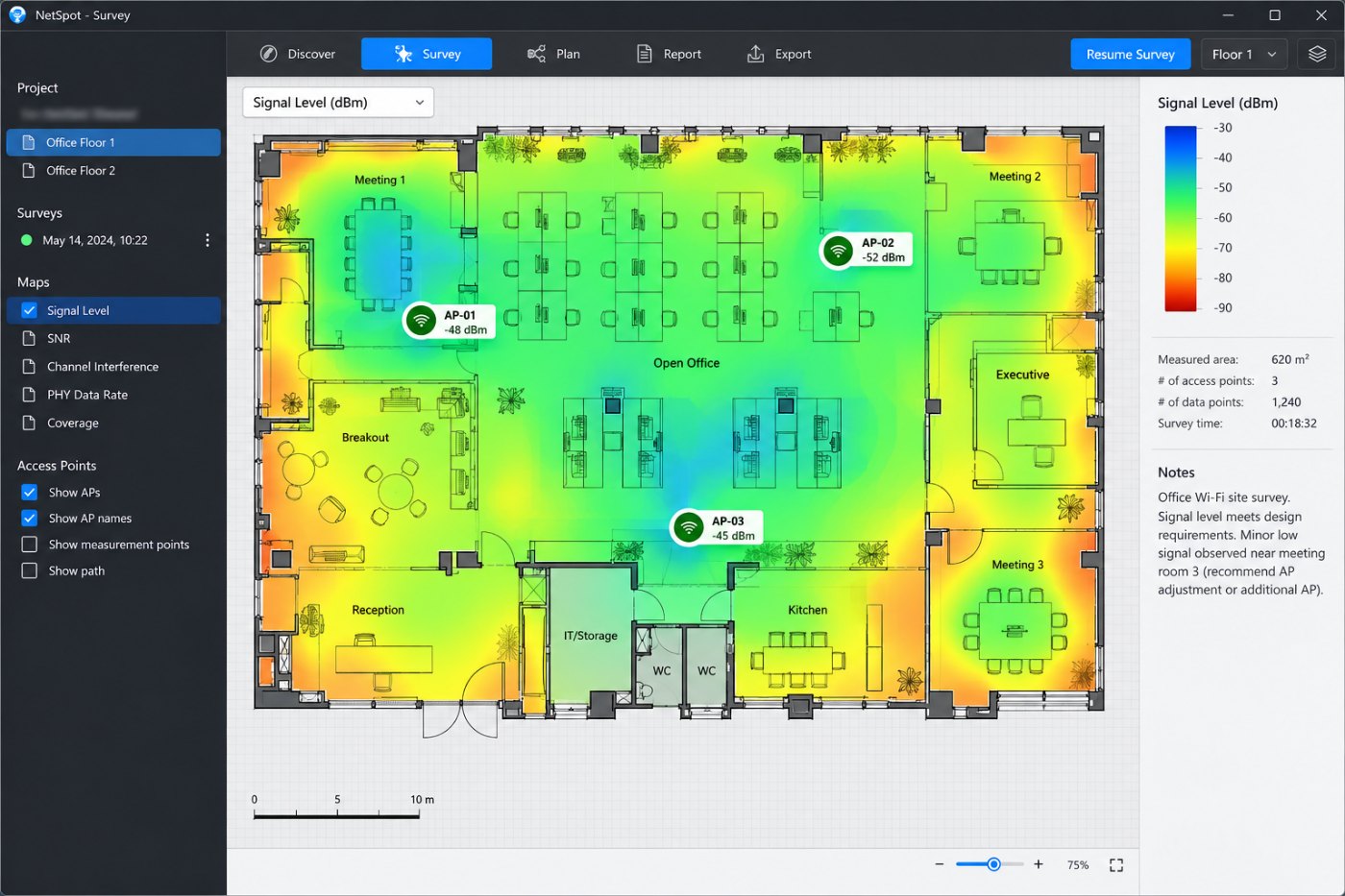
| Signal & SNR heatmaps | Per-floor coverage maps at the measured or modelled client height, per band, against agreed thresholds | Design and validation stages |
| Throughput heatmaps | Measured application-layer throughput across the floor, showing real capacity rather than bars | On-site and validation surveys |
| AP placement drawings | Scaled drawings with AP positions, models, mount type, antenna orientation and labels | Design stage, updated as-built |
| Channel & power plan | Channel assignment, width, transmit power and band steering per AP, with neighbour considerations | Design stage, finalised at validation |
| Bill of materials | APs, mounts, antennas, injectors, switches, PoE budget and cabling quantities, vendor-neutral | Design stage |
| Cable-drop schedule | Drop locations, lengths, containment route, patch panel and port assignments | Design stage, updated as-built |
| Survey report | Methodology, tooling, findings, interference sources, risks and recommendations in plain language | Each survey stage |
| Validation certificate | Measured performance against the agreed design targets, signed and dated | After post-install validation |
Deliverables are issued as documents you own, not as a portal view we can withdraw. Heatmaps are provided in a format your future engineers can open without our tooling.
The full path, if you want it
The environments that break generic designs
Any competent integrator can cover an open-plan office. These are the environments where survey discipline earns its cost.
Warehouses & high-bay racking
Stock is the problem: a rack full of goods attenuates completely differently from the empty aisle you surveyed. We survey loaded where possible, design for the worst realistic stock state, and use directional antennas down aisles rather than blanket omni coverage - particularly where scanners must roam at speed on forklifts.
Manufacturing RF noise
Motors, welders, induction heaters and legacy wireless equipment generate interference that a passive survey alone will not reveal. Spectrum analysis is mandatory here, and the design often trades raw coverage for channel cleanliness and directional control near the noise source.
Hospitals & clinical areas
Dense partitioning, lead-lined rooms, medical telemetry and zero tolerance for outage. Work is scheduled around clinical activity, surveys avoid patient areas at busy times, and voice and telemetry roaming are validated explicitly rather than assumed from coverage maps.
Dense offices & auditoria
The constraint is capacity and co-channel interference, not signal strength. Designs use narrower channels, lower power, more APs and careful band steering - the opposite instinct to coverage-led design, and the reason "just add another AP" usually makes an office worse.
Retail with analytics overlay
Stores need reliable POS and staff devices, guest WiFi, and often people-counting or footfall analytics on the same infrastructure. We design so the analytics overlay does not compromise transactional traffic, and validate POS performance separately from guest experience.
Outdoor & yard coverage
Weather, mounting constraints, point-to-point links and seasonal foliage. Designs account for the wet-day case rather than the survey-day case, with appropriate ingress protection and lightning management on external mounts.
Before and after, measured
A comparable engagement
A logistics operator was losing scanner sessions on forklift routes through high-bay aisles, forcing manual re-scans and slowing put-away. The incumbent recommendation was to add access points, which had already been tried once without improvement.
Discovery and spectrum survey showed the real causes: omni-directional APs mounted too high for aisle coverage, severe co-channel interference from the previous AP addition, and a design surveyed against empty racking. We remodelled in Ekahau AI Pro for the loaded state, moved to directional antennas down aisles, rebuilt the channel and power plan, and relocated more APs than we added.
Post-install validation certified coverage and roaming against design targets on the loaded floor, and scanner session drops fell sharply without the capital cost of a wholesale AP increase. The client now holds heatmaps, drawings and a channel plan as documentation.
Anonymised by agreement. Client names available under NDA.
Questions buyers ask
Can you survey without disrupting operations?
Yes. Passive surveys are a walk with a backpack and cause no disruption at all. Active and spectrum work is scheduled around operational patterns - out of trading hours in retail, around clinical activity in hospitals, between shifts in manufacturing. AP-on-a-stick testing needs brief access to specific locations, which we book in advance.
How is a multi-floor or multi-site survey priced?
By surveyable area and complexity rather than a flat per-site fee, because a warehouse floor and an office floor of the same size are not the same job. For multi-site estates we survey a representative sample of each building format, design to the format, then validate every site - which is substantially cheaper than surveying all of them fully.
Do we need to buy Ekahau licences or tooling?
No. Sidekick 2 hardware, Ekahau AI Pro and NetSpot licensing are ours, and the cost is inside the survey fee. You receive the deliverables in portable formats, so you are not dependent on our tooling to read your own documentation later.
Will this lock us into one wireless vendor?
No, and vendor-neutrality is deliberate. The survey and design outputs specify requirements - AP count, placement, antenna type, channel plan - which we can fulfil on Cisco, Meraki, Aruba, Ruckus or Ubiquiti, or on whatever you already own. Where a platform genuinely cannot meet the requirement we say so with the measurement behind it.
Are you designing for WiFi 6E and 6 GHz?
Yes, where client devices and regulatory position in that country support it. 6 GHz changes the design maths - more spectrum, shorter range, different power rules - so it is modelled explicitly rather than assumed as a free upgrade. In many estates the right answer is a 6E-capable design deployed in stages as the client fleet refreshes.
Other field service lines
WiFi complaints you cannot pin down?
A discovery and spectrum survey usually finds the cause in days. Tell us the sites and we will scope the right survey type rather than selling you all four.