

The physical layer, owned
What this practice does
Hardware is where global IT programmes quietly fail - not because the kit is wrong, but because it is in the wrong country, in a bonded warehouse, or on a pallet nobody has scanned. This practice owns the physical layer: buying it, holding it, staging it, moving it, and disposing of it with a certificate at the end.
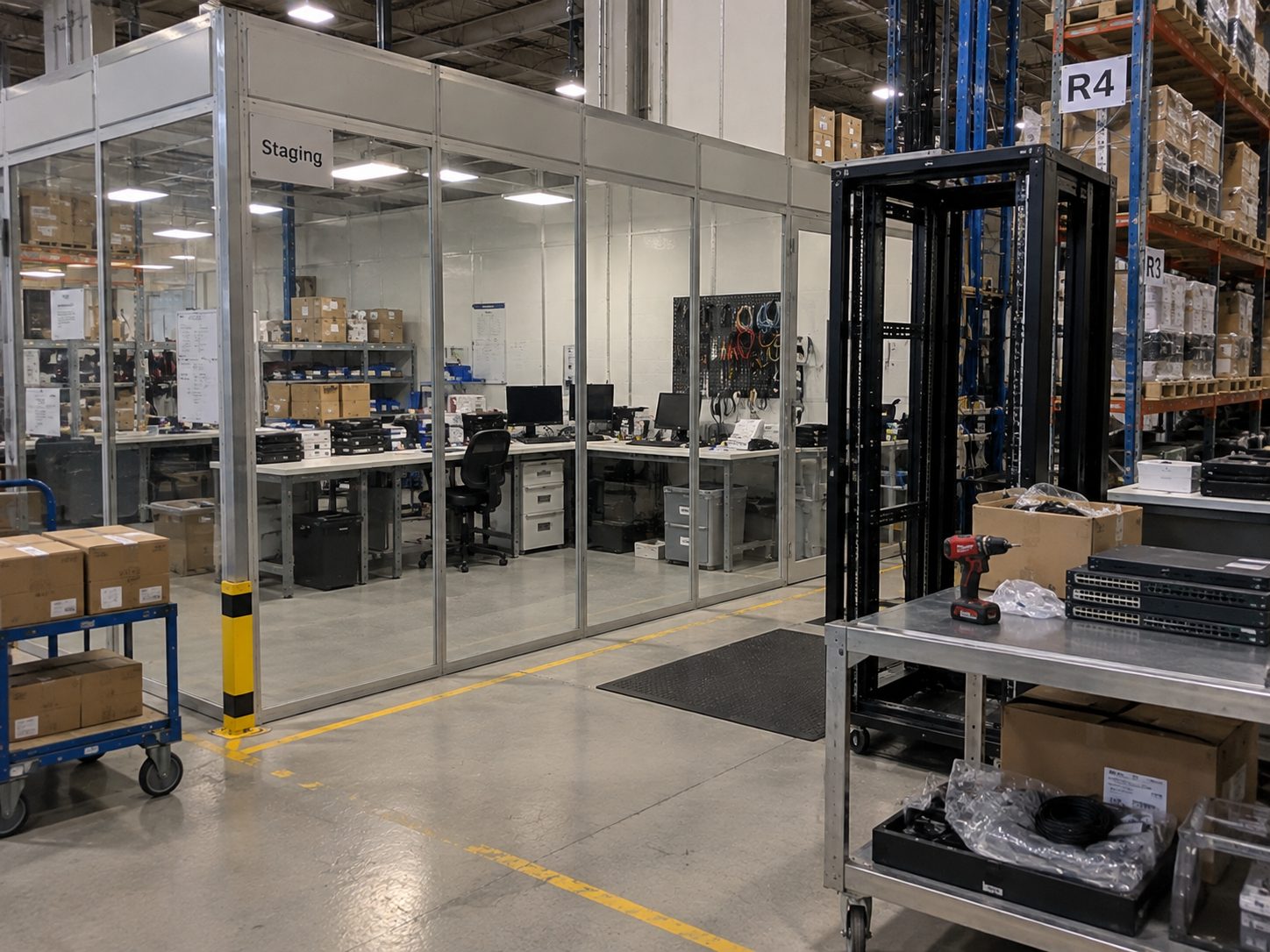
It works because the facilities are ours. Nineteen owned logistics warehouses, one at every entity, mean stock sits in-country with local customs and importer-of-record handling rather than being freighted per incident. Kitting, staging, imaging and burn-in happen on our bench, so what arrives on site is ready to install, and hot-spare pools sit close enough to the estate to hold a four-hour SLA honestly.
The disposal end is treated with the same seriousness as the build. Data destruction to NIST 800-88, chain of custody per asset, certified processing, resale value returned where there is any, and reporting that stands up to audit. Everything - stock, serials, movements, certificates - lives in Cogent OS against the asset record.
Hardware, Warehouse & Lifecycle at the centre
Each service line is its own contractable scope, and each runs on the same platform - so you can start with one and add the others without changing tools, portals or account teams.
& Lifecycle
lifecycle
One lifecycle, six stages, no gaps
Most estates leak at the joins: kit bought in one country and used in another, spares held where the failures are not, leavers keeping devices, and disposal evidence that cannot be produced at audit. Each of those is a handover between suppliers.
We own every stage. Procurement receives into our own warehouse, staging and kitting happen on our bench, deployment is by our own workers, spares sit in our facility in the country of the fault, returns come back to the same bin, and end-of-life exits through our certified disposal line with a certificate per asset.
One asset record carries the serial from purchase order to destruction certificate. Click any stage to open it.
Capabilities across the practice
IT Procurement
Vendor-neutral sourcing, standard build catalogues, framework pricing and lead-time management across regions.
Warehouse as a Service (WaaS)
Dedicated or shared space in our own hubs, receipting, put-away, cycle counting and live stock visibility.
3PL & Forward Logistics
In-country distribution, site-level delivery scheduling, importer of record and customs handling.
Kitting, Staging & Imaging
Build to your standard, image, asset-tag, kit per site and burn-in before dispatch.
Hot-Spare Pools
Spares held per country against SLA commitments, drawn down on the work order, replenished automatically.
Reverse Logistics & RMA
Collection, triage, warranty claim handling and return to stock or disposal, tracked per serial.
ITAD & Secure Disposal
NIST 800-88 data destruction, degaussing and shredding, certificates per asset, resale and recycling.
WEEE & Compliance Reporting
WEEE-registered disposal with audit-ready reporting, plus environmental and diversion metrics.
Asset lifecycle - end to end on Cogent OS
The lifecycle on the left, the platform tooling that runs it in the middle, and the quality loop that holds it on the right. This is the same structure across all eighteen service lines, tuned per practice.
Measured, not asserted
One SLA framework, applied here too
| PRIORITY | DEFINITION | RESPONSE | TARGET RESOLUTION | UPDATES |
|---|---|---|---|---|
| P1 - Critical | Service down, site or revenue-critical system unavailable | 15 minutes | 4 hours | Hourly |
| P2 - High | Major degradation or a group of users affected | 30 minutes | 8 hours | Every 2 hours |
| P3 - Medium | Single user or non-critical function impaired | 2 hours | Next business day | Daily |
| P4 - Low | Request, change or scheduled work | 8 hours | 5 business days | On progress |
Indicative framework - targets are agreed per contract and measured in Cogent OS against the ITIL priority matrix. Attainment reported monthly and reviewed at QBR.
Four things that are hard to copy
The hubs are ours
Nineteen owned facilities, one per entity - not brokered pallet space with someone else's priorities.
Stock in-country
Local customs and importer-of-record handling, so spares are hours away rather than a freight booking.
Ready to install
Imaged, tagged, kitted and burned in at the hub, so site time is installation time, not unboxing time.
Disposal that survives audit
Certificates per asset, NIST 800-88 destruction, NAID AAA and R2v3 aligned, WEEE reported.
Questions buyers ask
What does Warehouse as a Service actually give us?
Space, process and visibility in our own facilities: receipting and put-away, bin-level and serial-level stock control, kitting and staging to your build standard, cycle counting, and despatch scheduling to sites. You see live stock, movements and serials in the portal rather than asking for a spreadsheet, and you are not paying for a facility you have to run.
Can you hold spares to support a four-hour SLA?
Yes, and this is the usual reason clients pair this practice with field services. Spares are modelled per country against the estate and the SLA, held at the nearest owned hub, drawn down against the work order, and replenished automatically to agreed minimum levels. Fill rate is reported monthly.
How do you handle customs and importer of record?
Through the local entity. Each of our nineteen entities can act as importer of record in its country, which means equipment clears into local stock properly rather than sitting in a bonded facility while a project waits. Duties, documentation and compliance records are held against the movement in Cogent OS.
What certification do we get on disposal?
A certificate of data destruction per asset with the method used - NIST 800-88 compliant erasure, degaussing or physical shredding as appropriate - plus chain of custody from collection to processing, WEEE reporting, and a settlement statement where assets carried resale value. Our processing is aligned to NAID AAA and R2v3.
Do you resell recovered equipment, and do we see the value?
Where equipment has residual value we remarket it and return the agreed share to you, netted against disposal costs and reported per batch. Where it does not, it is recycled through the same certified route. In both cases the audit file is the same, so compliance does not depend on the commercial outcome.
Where this connects
This practice's service lines
Ready to scope this?
Tell us the countries, the sites and the service levels. We will show you which entity, which hub and which workers deliver it.