

What we have already built
Delivered by our own DC-cleared workers, on Cogent OS, under change control.
AI infrastructure is a physics problem before it is a software one
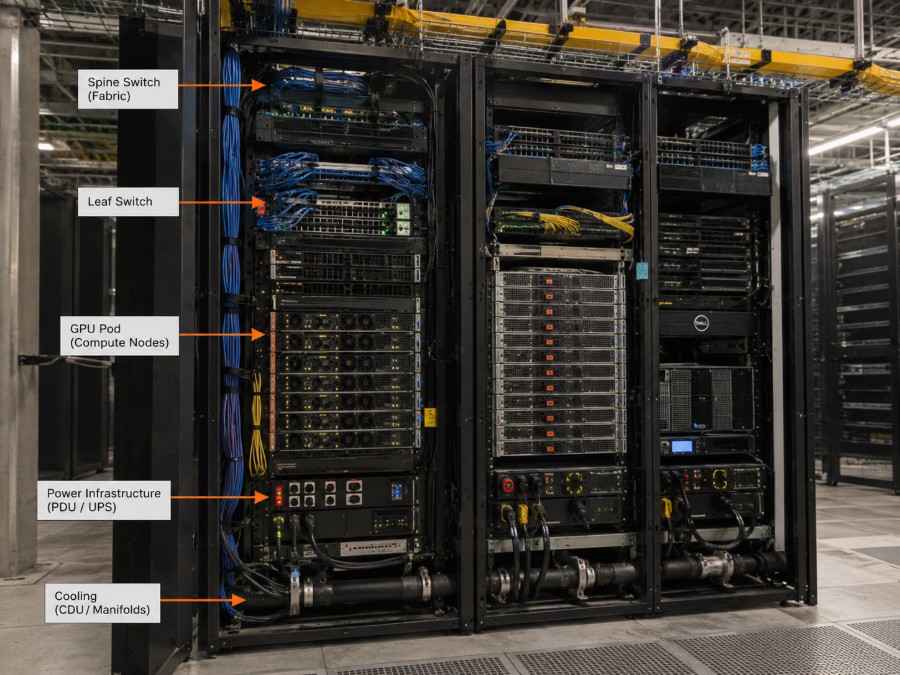
A GPU rack is not a denser version of a server rack. It weighs one and a half to two tonnes or more, needs 20 to 25 kN per square metre of floor loading, draws 30 to over 100 kW, and rejects that heat into a room that was probably designed for a fifth of it.
That is why we treat AI deployment as an engineering discipline that starts at floor loading and feed capacity and ends at cluster validation under load. Design first: architecture, capacity, topology, power and cooling strategy, agreed with your own architects. Then deployment by DC-cleared workers who have handled this weight and this density before.
We are vendor-neutral across accelerator, network and storage platforms, so the design answers your workload rather than a partner quota. Every serial is tracked in Cogent OS from goods-in at one of our nineteen hubs through burn-in to production.
Three delivery blocks
Rack & stack deployment
Physical deployment of GPU-dense and conventional infrastructure, engineered for the weight and the cable volume rather than improvised on the floor.
OS installation & configuration
Platform build at scale, to a baseline you can reproduce - firmware, drivers and hardening applied consistently rather than machine by machine.
Infrastructure provisioning
The layer that turns installed hardware into a usable platform, including the cluster bring-up that most deployments underestimate.
Platforms and services
Vendor-neutral across the platforms our clients actually run. The service column applies to every platform in the left column.
| PLATFORMS WE BUILD | SERVICES APPLIED TO EACH |
|---|---|
| Windows Server | Installation, firmware and BIOS baseline, drivers, RAID, hardening, tuning, patching, validation |
| Ubuntu Server | Installation, kernel and driver validation, hardening, performance tuning, patch management |
| Red Hat Enterprise Linux | Installation, subscription and repository config, hardening, tuning, validation |
| Rocky Linux | Installation, driver and firmware baseline, hardening, patch management |
| VMware ESXi | Host build, cluster configuration, storage and network presentation, validation |
| Microsoft Hyper-V | Host build, cluster and storage configuration, validation |
| NVIDIA AI Enterprise | Stack deployment, driver and container runtime validation, GPU allocation |
| Kubernetes | Cluster deployment, GPU scheduling, orchestration and monitoring integration |
Where a platform outside this list is in scope we say so at design stage rather than absorbing it silently. Baselines are documented and handed over so your team can reproduce the build.
From infrastructure to production AI
Whether it is generative AI, machine learning, computer vision or large language models - we accelerate the transformation rather than handing over hardware and wishing you luck.
Every successful AI deployment begins with the right architecture
Our infrastructure specialists and solution architects design alongside your teams - not in isolation, and not as a document delivered after the hardware is ordered.
Five technologies that decide whether AI infrastructure works
AI-optimised liquid cooling
Thermal efficiency up, power draw and operating cost down. At the densities modern accelerators run, air cooling stops being a choice and becomes a ceiling - liquid is what lets a rack reach its rated compute rather than throttling to survive the room.
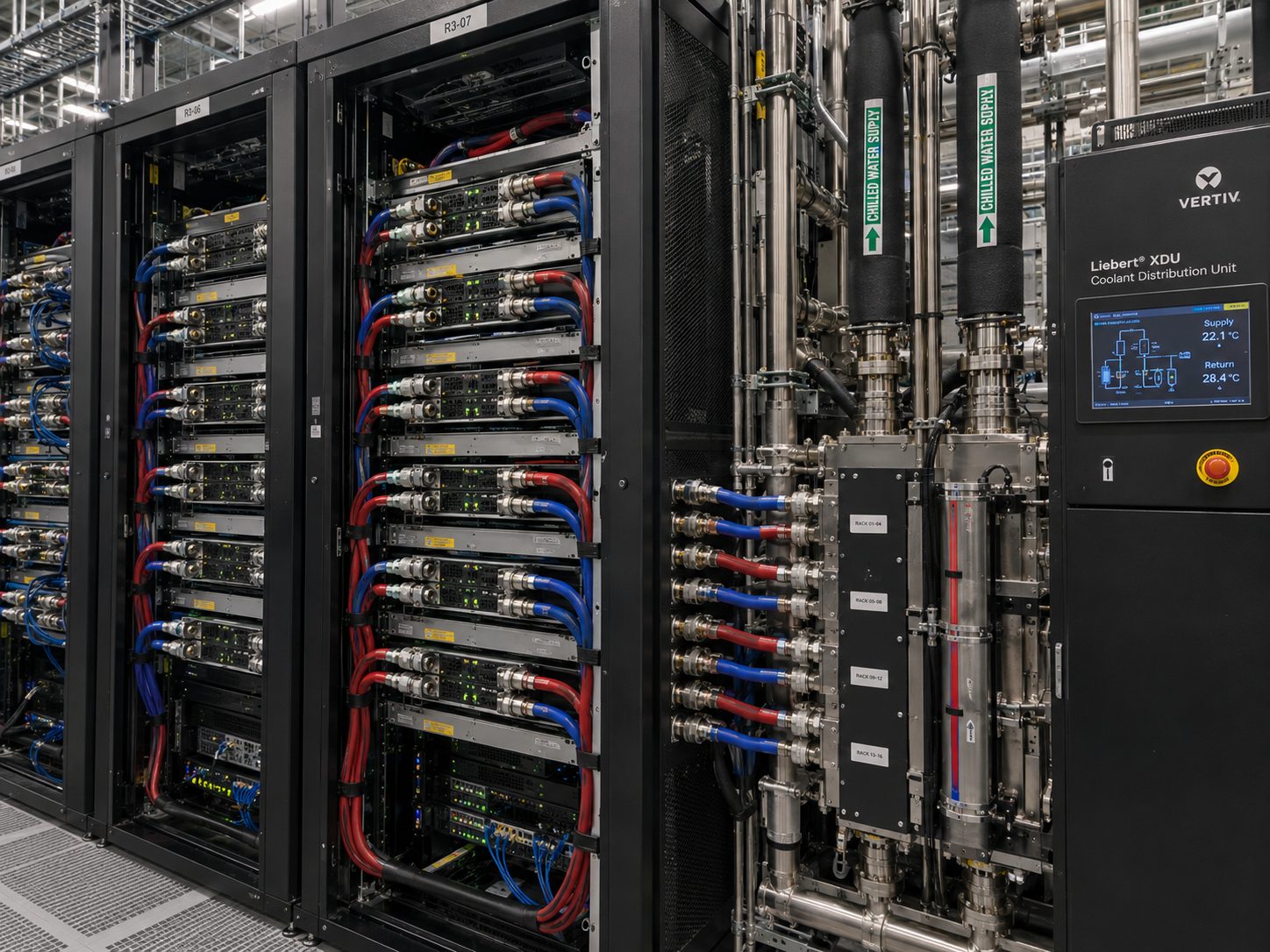
Cold plates on the accelerators and CPUs, with manifolds and a coolant distribution unit serving the rack. Cools modern accelerators and CPUs directly, supports higher compute density and improves energy efficiency, while leaving the rest of the room air-cooled.
Hardware submerged in dielectric fluid. Suits ultra-high-density clusters, lowers cooling cost substantially and delivers maximum sustained performance, at the price of a fundamentally different maintenance model and floor design.
When each wins: direct-to-chip is usually the right answer for a retrofit - it can be introduced rack by rack into an existing air-cooled hall with manifold and CDU work rather than a floor rebuild. Immersion tends to win on greenfield builds at scale, where the tank format, floor loading and service model can be designed in from the start rather than worked around.
High-density GPU infrastructure
The latest GPU platforms for training, inference and scientific computing, deployed at 30 to over 100 kW per rack. Ideal for large language models, deep learning, machine learning, computer vision, scientific research and digital twins - workloads where the constraint is rarely the software.
High-speed AI networking
Low-latency, high-bandwidth fabrics designed east-west, because cluster performance is decided by how nodes talk to each other rather than by uplink capacity.
Intelligent power infrastructure
Power designed for a load profile that spikes hard and sustains, with the instrumentation to see it happening rather than infer it from the bill.
Data centre cooling solutions
The air-side engineering that has to work alongside liquid, and the analytics that keep it optimal as load changes.
Enterprise AI factories supporting thousands of GPUs
An AI factory is not a big cluster; it is a facility whose fabric, storage, power and cooling were designed as one system for a known workload mix. Get one layer wrong and the expensive layer sits idle.
We deliver AI factory design, HPC deployment, GPU cluster integration, distributed storage, high-speed fabric design and workload optimisation - as a single engagement with one design authority rather than four suppliers optimising their own layer.
Hardware is received, staged, firmware-baselined and burned in at the nearest of our nineteen owned hubs before it reaches your floor, so the on-site window is spent on placement, connection and validation.
Infrastructure automation
Reduce deployment time and operational complexity through intelligent automation - and make the build reproducible, which matters more than the time saved.
Ten things, and why they are true of us specifically
Direct, DC-cleared crews
The workers on your floor are Cogent employees with current facility inductions tracked in Cogent OS, so clearance cannot lapse into a missed window. Not a brokered crew whose vetting you cannot verify.
Nineteen hubs for GPU staging
Accelerator hardware is received, firmware-baselined, racked, cabled and burned in at the hub nearest your site, then delivered ready to energise. High-value kit does not sit in a corridor.
Every serial in one system
From goods-in through burn-in to production and eventual certified disposal, each device is one record - which is what makes warranty, audit and capacity reporting a query rather than a reconstruction.
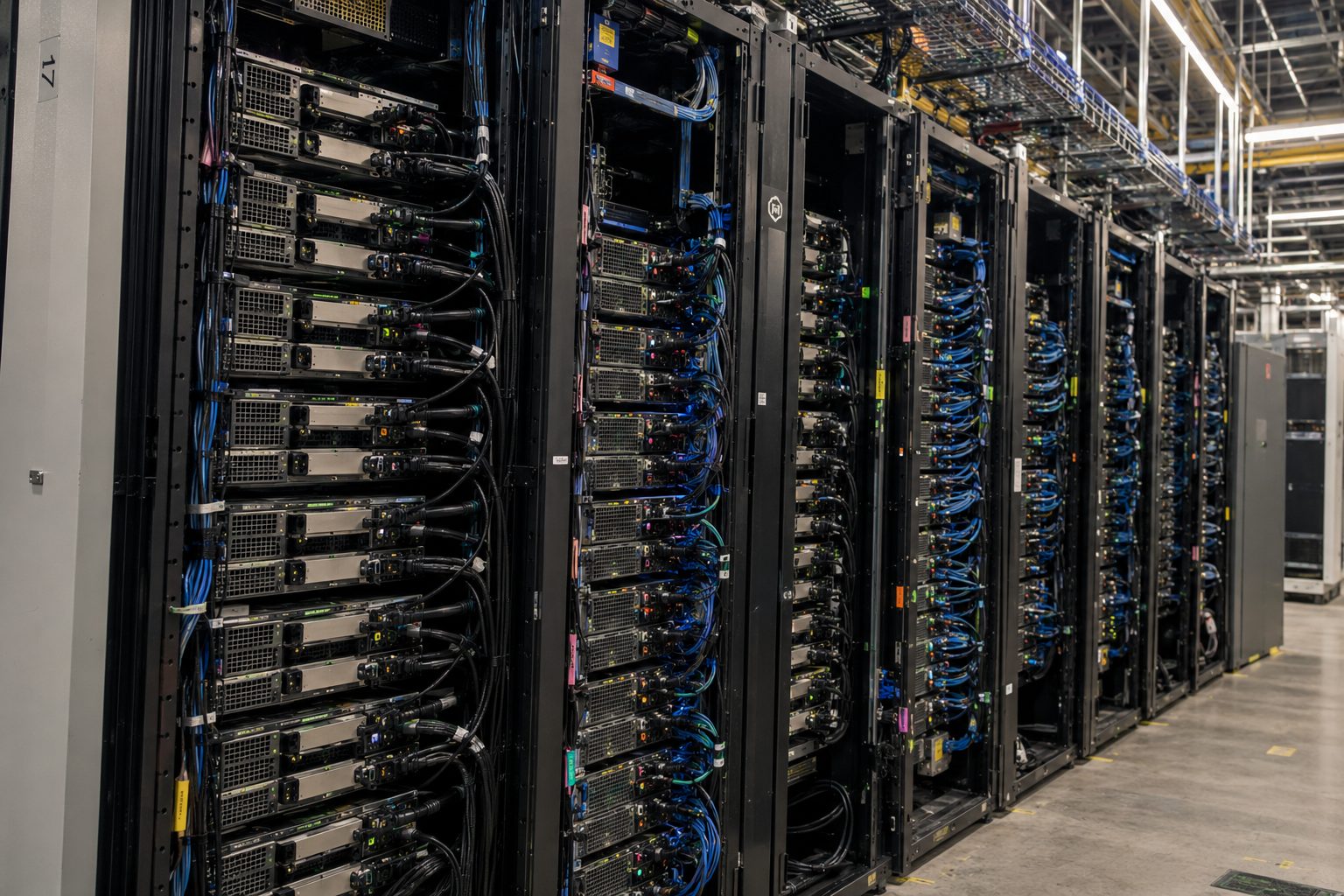
The environment we work in
Questions buyers ask
Can you assess whether our hall is liquid-cooling ready?
Yes, and it is the sensible first engagement. The assessment covers floor loading against rack weight, feed capacity and headroom per row, containment and airflow behaviour today, water or coolant availability and routing, drainage and leak-detection provision, and the service access a manifold and CDU design needs. The output states what the hall can support now, what a retrofit would require, and where the honest answer is a different room.
Do you burn in hardware before it reaches our floor?
Yes. Accelerator and server hardware is received at the nearest of our nineteen hubs, firmware and BIOS baselined, racked and cabled to the elevation, then burned in and soak-tested. Failures surface at the hub where a replacement is straightforward, rather than in your change window. Our test lab handles build validation, firmware baselining and failure reproduction for RMA evidence.
Are you tied to particular OEMs?
No. We are vendor-neutral across accelerator, network, storage and cooling platforms, and we hold no volume commitments that would bias a design. Where a platform is genuinely the better fit for your workload we will say so with the measurement behind it, and where a client has an existing framework agreement we design within it and state the constraints that creates.
How far into the AI stack do you go?
As far as production. Infrastructure and platform is the core: cluster deployment, fabric, storage, orchestration and GPU scheduling. Above that we deliver MLOps pipelines, inference and LLM serving platforms, and application integration into your enterprise systems. What we hand over is documented and reproducible - code, runbooks and baselines - so your data science team is not dependent on us to change anything.
Can you support the cluster once it is live?
Yes, through the same operational bands as the rest of our data centre practice: smart hands and DC L2 support with cleared workers, spares held in-country against the SLA, NOC monitoring integrated into the same ticket model, and problem management on repeat failures. GPU hardware fails in specific patterns and we track them per model rather than treating each event as isolated.
Let us build the future of AI - together.
Whether you are launching a new AI data centre, modernising infrastructure, deploying GPU clusters or enabling enterprise AI applications, we provide the expertise, the technology and the execution.